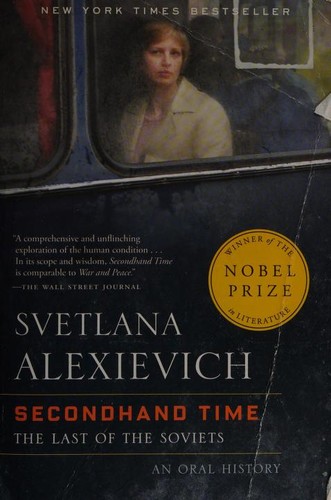
I’ll admit the embarrassing part first, my own library copy went back on the shelf before I finished it and I had to get back in the hold queue behind myself, essentially, which has never happened to me with a book I actually liked before. That’s not a knock on Alexievich, it’s what this book does to you, one voice after another, ordinary people talking about the Stalin years, the war, the fall of the USSR, and the strange disorienting decade after, and you can only take so much of it in one sitting before you need to put it down and just sit with what you read.
The oral-history format is the whole point and it works precisely because nobody’s story gets smoothed into a thesis. One woman’s grief about a suicide sits next to a man’s genuine nostalgia for Soviet scientific achievement sits next to somebody explaining, almost offhand, that the oligarchs got the bagel and everyone else got the hole. That image alone told me more about the transition to capitalism than any econ textbook I’ve assigned at story time for adults, which is a joke, we don’t do that, but you get what I mean.
If you’ve read Francis Spufford’s Red Plenty, this is the ideal companion, that book gives you the planners and economists watching their system fail from the inside, this one gives you the people who actually lived through the failure without a policy view of it. My one real gripe is structural, the interviews run long without always marking a time period clearly, so I occasionally lost track of whether I was reading a Brezhnev-era memory or a 1990s one until a detail gave it away.
Five stars. It’s not a comfortable read and it shouldn’t be. It’s one of the most humane books I’ve handed to a patron this year.