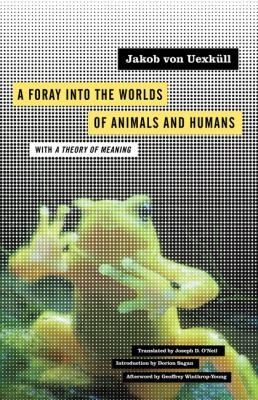
Nobody I know has read this and I mean that literally, I mentioned it to two coworkers who both assumed I’d made the title up. Von Uexküll’s core idea, the umwelt, that every organism doesn’t perceive the world so much as construct its own small functional slice of it, a tick’s umwelt built entirely from heat and butyric acid and nothing else, is one of those ideas that’s quietly everywhere in later thought once you know to look for it. You can trace a straight line from this book to Heidegger and Merleau-Ponty, and honestly to a fair amount of contemporary animal cognition writing that never bothers to cite it.
The book itself is short, closer to a long essay than a treatise, and that’s both its charm and its limitation. Von Uexküll leans hard on musical metaphors, the world as a symphony each creature only hears certain instruments of, and while it’s a genuinely useful image the first two times, by the fifth or sixth iteration it starts feeling less like insight and more like a stylistic tic he never quite let go of. I found myself wishing he’d trusted the underlying concept enough to state it more plainly instead of dressing it up again in the same costume.
Where this earns its four stars is in how much it changes casual observation. I’ve caught myself looking at the dog on my street differently since reading this, wondering what her actual umwelt contains that mine doesn’t, and that kind of lingering effect is rare from a book this short. If you have any patience for early 20th century biology written by someone more philosopher than empiricist, this rewards the effort. If you want data and citations, look elsewhere.